
Rasdi & Sri Ulfanita
Mathematics education plays a crucial role in developing students’ critical, logical, systematic, and creative thinking skills. Through mathematics learning, students not only learn to calculate or understand formulas but also learn how to analyze a problem and find the right solution. These abilities are highly necessary in everyday life because mathematics is closely related to various human activities. Therefore, mathematics education must help students develop higher-order thinking skills to meet the challenges of the times. In line with this, mathematics also plays an important role in improving students’ logical, critical, and systematic thinking skills (Siswanto & Meiliasari, 2024).
One of the most important skills in mathematics learning is mathematical problem-solving ability. This ability becomes a main indicator of the success of mathematics learning because through problem-solving skills, students can understand problems, devise solution strategies, execute solutions, and evaluate the results obtained. According to Panjaitan (2023), problem-solving ability is the capacity to apply prior knowledge to new situations involving higher-order thinking processes. In line with this opinion, problem-solving ability is an essential element in the mathematics curriculum as it is considered the heart of mathematics learning (Siswanto & Meiliasari, 2024).
However, the mathematical problem-solving ability of Indonesian students remains relatively low. Based on the 2022 Programme for International Student Assessment (PISA) results, Indonesian students’ mathematical abilities are still below the international average, especially in solving problems that require reasoning and contextual problem-solving (OECD, 2023). Many students experience difficulties in understanding word problems, determining solution strategies, and drawing conclusions from the answers obtained. The low mathematical problem-solving ability of students is influenced by the learning process, which is still teacher-centered, resulting in students being less active in the learning process (Nasution, 2026).
The dominance of conventional learning causes students to become accustomed to receiving information directly from the teacher without being given the opportunity to discover concepts independently. Teacher-centered learning causes students to rely on teacher explanations, leading to low mathematical problem-solving abilities among students (Soniawati, 2022). Therefore, a learning model is needed that can actively involve students in the learning process so that they can better develop their critical thinking and mathematical problem-solving skills.
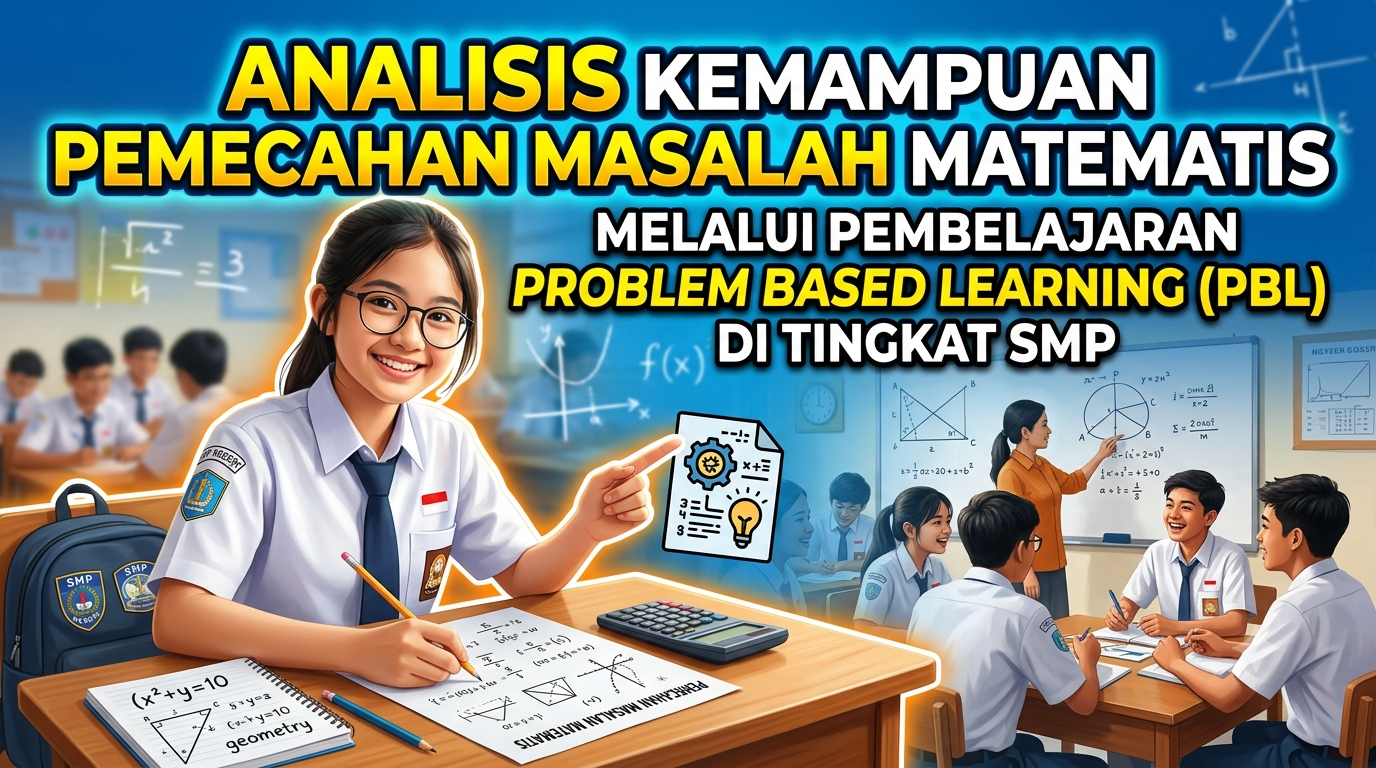
One learning model considered effective in overcoming these problems is Problem-Based Learning (PBL). This learning model centers on presenting real-world problems that students must solve through critical thinking, discussion, and group collaboration. Problem-Based Learning has proven effective in improving students’ mathematical abilities, including mathematical problem-solving skills (Siddik et al., 2025). Furthermore, PBL is considered effective because students can search for solutions and solve problems independently, making learning more meaningful (Zetriuslita & Riyanti, 2026). Thus, the mathematical problem-solving ability of junior high school students in Indonesia, which is still relatively low due to the dominance of teacher-centered learning, can be improved through the implementation of the Problem-Based Learning (PBL) model, which is capable of enhancing critical thinking, conceptual understanding, and active student involvement in mathematics learning.
In a broader context, mathematical problem-solving ability is one of the essential competencies that students must possess. This ability is not only related to the cognitive aspect of calculating but also involves a deep process of understanding the problem, determining solution strategies, executing the solution, and reviewing the results obtained. Mathematical problem-solving skills help students develop a logical and systematic mindset (Siswanto & Meiliasari, 2024). Additionally, this ability is defined as the capacity to apply prior knowledge to new situations involving higher-order thinking processes (Panjaitan, 2023).
Mathematical problem-solving ability consists of several main components, namely understanding the problem, planning the solution, carrying out the solution, and evaluating the result. These stages correspond to Polya’s problem-solving steps, which include understanding the problem, devising a plan, carrying out the plan, and looking back at the completed solution (Polya in Nasution & Siregar, 2026). In the learning process, students must be able to comprehend the information contained in the problem, determine the appropriate solution method, and then solve the problem systematically. According to Siswanto & Meiliasari (2024), these problem-solving steps are important for training students’ critical and analytical thinking skills in solving mathematical problems.
In daily life, mathematical problem-solving skills are highly needed. For instance, students use mathematical skills when calculating expenses and income, determining travel distance, or solving problems related to data and calculations. Problem-solving skills help students make logical and systematic decisions in everyday life (Panjaitan, 2023). Therefore, mathematical problem-solving ability is not only important for learning in school but also for daily life.
Based on this, mathematical problem-solving ability can serve as an indicator of the success of mathematics learning. If students can solve mathematical problems well, the learning can be considered successful because students not only understand the theory but are also capable of applying mathematical concepts in various situations.
Despite its crucial role, the low mathematical problem-solving ability of students remains a major challenge in the Indonesian education system. Many students struggle when faced with problems requiring deep reasoning and analysis. These difficulties indicate that students are not yet accustomed to solving contextual or non-routine problems. This reality is reinforced by international studies such as PISA, which show that the performance of Indonesian students is still below the international average in terms of problem-solving (Nasution & Siregar, 2026).
One of the main factors causing students’ low mathematical problem-solving ability is the learning process, which is still teacher-centered. In conventional learning, teachers mostly explain the material and provide sample problems, while students merely listen and copy the given solution methods. As a result, students become passive and less trained to think critically or find solutions independently. Students accustomed to conventional learning tend to rely on teachers, leading to low problem-solving abilities (Soniawati, 2022). Moreover, learning that overly focuses on rote memorization of formulas causes students to struggle when facing problems that differ from the examples given by the teacher.
These issues are corroborated by the results of the 2022 Programme for International Student Assessment (PISA), which show that Indonesian students’ mathematical abilities are still below the international average (OECD, 2023). Many students face difficulties in solving problems related to real life because such problems require the ability to understand the issue and determine the appropriate solution strategy. The research results by Soniawati (2022) showed that students’ ability to understand problems only reached 49%, the ability to devise a plan was 23%, and the ability to look back at the answer was only 9%. This data indicates that students’ mathematical problem-solving abilities still need improvement.
Based on these conditions, it can be concluded that mathematics learning in Indonesia still requires improvement, especially in the use of learning models that can actively engage students. Teachers need to implement learning models that can help students optimally develop critical thinking and mathematical problem-solving skills.
As an effort to overcome these obstacles, the Problem-Based Learning (PBL) model emerges as an effective solution. This model places real problems at the center of learning, thereby encouraging students to think critically, seek information independently, and collaborate in groups. PBL focuses on authentic problem-solving to sharpen students’ thinking acuity and strategic abilities in mathematics (Siddik et al., 2025).
Problem-Based Learning has several main characteristics: student-centered learning, the use of contextual problems, group collaboration, and an investigative process to find solutions. In its implementation, the teacher acts as a facilitator who guides students during the learning process. PBL is considered effective because students can independently search for solutions and solve problems, making learning more meaningful (Zetriuslita & Riyanti, 2026). In addition, the PBL model can also increase active student involvement in the mathematics learning process.
The implementation of PBL in mathematics learning can be done through group discussions and the presentation of problems related to everyday life. For example, students are asked to solve problems regarding land area calculation, simple financial management, or statistical data issues frequently encountered in real life. Through these activities, students become more active in thinking, discussing, and expressing their opinions. Zakiyah (2023) states that the PBL learning model can encourage students to think critically and solve the problems they face independently.
Research results indicate that the application of Problem-Based Learning has a positive effect on the mathematical problem-solving ability of junior high school students (Arfiani & Rismen, 2025). Additionally, students who learn using the PBL model have better problem-solving abilities compared to those who learn using conventional instruction (Nasution & Siregar, 2026). The study by Zetriuslita & Riyanti (2026) also shows that the PBL model has a significant impact on improving students’ mathematical problem-solving abilities. Thus, Problem-Based Learning can be an effective solution for enhancing students’ mathematical problem-solving abilities.
Overall, the challenge of low mathematical problem-solving ability in Indonesia requires a transformation in instructional methods. The condition where students often struggle to understand problems or determine solution strategies is frequently rooted in an overly passive learning process. By integrating a more dynamic learning model such as PBL, students are trained not only technically but also mentally to become independent and collaborative problem solvers.
Problem-Based Learning is one of the relevant learning models to address these issues. Through problem-based learning, students are trained to think critically, work together, and solve problems independently. Various research results show that the implementation of Problem-Based Learning can significantly improve the mathematical problem-solving ability of junior high school students.
Therefore, the application of Problem-Based Learning is expected to make a positive contribution to the development of mathematics learning in Indonesia. With the use of the right learning model, students are not only able to understand mathematical concepts but are also able to apply them in everyday life and possess strong critical thinking skills.